Installing a diesel generator entails more than placing the equipment and connecting it to the electrical system. DG set installation requires planning for the foundation, ventilation, exhaust routing, fuel access, clearances and noise control. Addressing these factors before commissioning can support reliable operation and simplify diesel engine maintenance.
For facility engineers and contractors, this diesel generator installation guide covers the key site-readiness requirements before installation.
What Should Be Considered Before Installing a Diesel Generator?
Before the installation of a diesel generator set, assess the site for equipment access, structural support, airflow, exhaust discharge, fuel handling and electrical connections. Indoor and outdoor installations should follow the manufacturer’s layout and clearance requirements.
1. Where Should a DG Set Be Installed?
The first step in DG engine set installation is selecting a location with sufficient space for operation, inspection, servicing and component removal. It should provide safe access to the fuel system and electrical connections, along with suitable routes for exhaust piping and airflow.
The area should also be protected from flooding, excessive dust and other site hazards. For indoor installations, room dimensions and equipment positioning should follow the manufacturer’s recommended clearances.
2. How Should the Generator Foundation Be Prepared?
A stable foundation must support the genset’s operating weight and manage vibration from the engine and alternator. A reinforced concrete foundation is commonly used, with its design based on the equipment’s dimensions, weight, mounting arrangement and manufacturer’s recommendations.
Anti-vibration mounts or isolation systems may be required to limit vibration transmission to the building. The foundation should be level, properly finished and adequately cured before equipment placement.
3. What Are the Generator Room Ventilation Requirements?
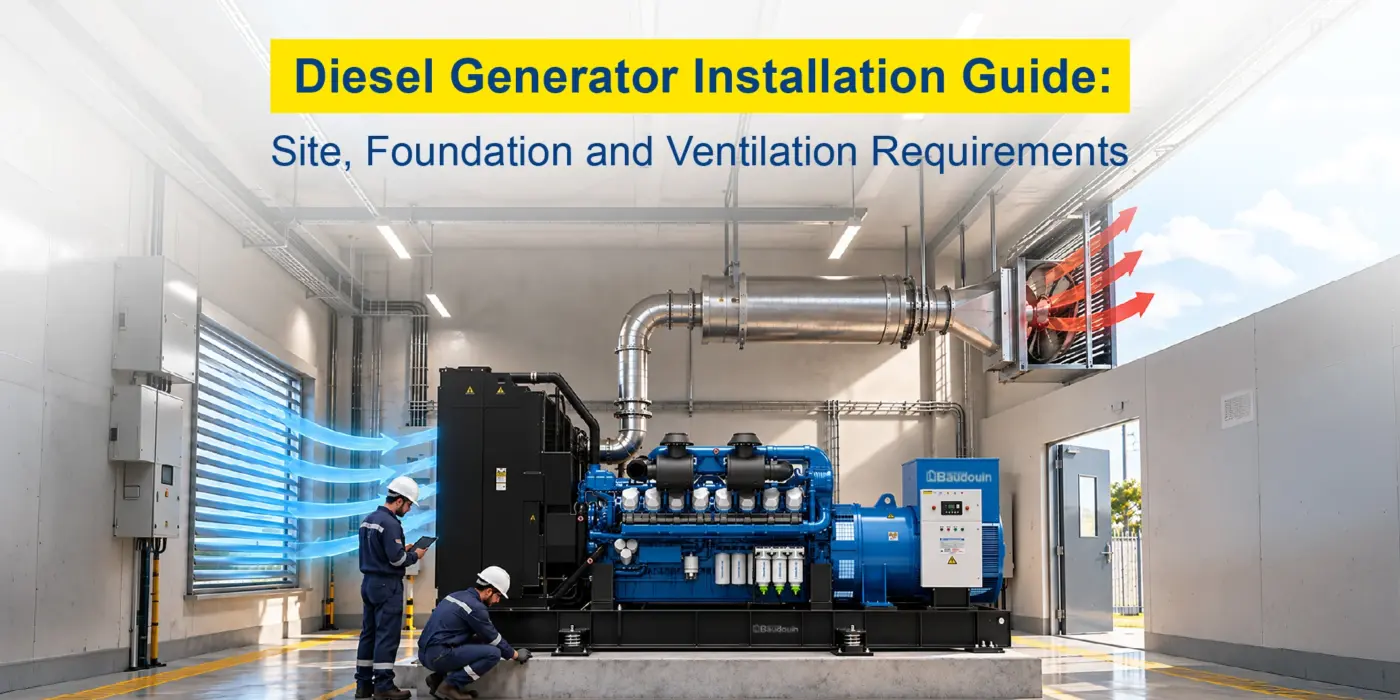
Ventilation is a key part of DG set installation guidelines because a diesel engine for a generator consumes combustion air while generating heat. The room must provide fresh air and remove heated air without excessive recirculation.
Key generator room ventilation requirements include:
| Requirement | Installation consideration |
| Combustion air | Provide adequate fresh air for engine operation |
| Radiator airflow | Maintain the recommended airflow path |
| Hot-air discharge | Direct heated air outside the room |
| Air intake | Minimise hot-air recirculation |
| Room layout | Keep airflow paths unobstructed |
Ventilation should be based on the manufacturer’s airflow and heat-rejection data. Poor airflow can raise room temperature and affect engine and alternator operation.
4. How Should the Exhaust System Be Planned?
Exhaust routing is a critical part of installation of diesel generator set planning. Exhaust gases should be discharged safely outside the building, away from occupied areas and air intakes.
Pipe diameter and routing should account for exhaust flow, allowable back pressure, total pipe length and bends. An excessively restrictive system can increase back pressure and affect engine operation.
The exhaust system should be adequately supported and insulated where required, with the discharge point planned around nearby buildings, windows and ventilation openings.
5. How Should Fuel, Electrical and Service Access Be Planned?
Fuel storage and supply arrangements should be planned during installation to provide safe access for refuelling, inspection and servicing while meeting applicable requirements.
Electrical connections should include appropriately rated cabling, protection systems, earthing and changeover or synchronisation equipment based on the application.
Maintenance clearance is equally important. Filters, batteries, belts, fluids and other service points should remain accessible to simplify diesel engine maintenance.
6. What Noise and Emission Requirements Apply?
Noise control should be incorporated during planning. CPCB guidance requires applicable DG set installations to follow manufacturer recommendations and provides requirements for acoustic enclosures and exhaust mufflers. For applicable diesel generator sets up to 1,000 kVA, CPCB documentation specifies a 75 dB(A) at 1 metre noise limit. (source)
Emission requirements should also be checked before installation. CPCB regulations cover generator-set emissions, including gaseous and particulate pollutants. Projects requiring CPCB IV+ diesel engines should verify that the selected engine and genset meet applicable regulatory and certification requirements.
7. What Should Be Checked Before Commissioning?
Before commissioning, verify:
- Foundation and mounting are complete
- Ventilation and airflow paths are ready
- Exhaust piping is complete and supported
- Fuel connections are secure
- Electrical connections and earthing are complete
- Service clearances are available
- Emergency access is unobstructed
- Noise and emission requirements are addressed
- Manufacturer-specific requirements are followed
Conclusion
A successful diesel generator installation starts with equipment suited to the site’s load, operating conditions and infrastructure. Engine rating, ambient conditions, ventilation, exhaust design and service access should be considered together.
For organisations finding diesel engine manufacturers in India, Baudouin offers diesel power generation engines and generator solutions for industrial and commercial applications. Its portfolio includes CPCB IV+ diesel engines, supported by application and service capabilities in India.
A well-planned DG set installation provides the physical and environmental conditions needed for dependable operation, from the foundation and airflow to exhaust routing and maintenance access.
FAQs
What are the basic requirements for diesel generator installation?
Key requirements include a suitable location, stable foundation, adequate ventilation, safe exhaust routing, proper fuel and electrical connections, sufficient maintenance clearance, and compliance with applicable noise and emission requirements.
How much ventilation is required for a diesel generator room?
Ventilation requirements depend on the generator’s airflow, heat rejection and room configuration. The design should provide sufficient combustion air and remove radiator and room heat based on the manufacturer’s specifications.
Can a diesel generator be installed outdoors?
Yes. A diesel generator can be installed outdoors when the location provides adequate clearance, ventilation, weather protection, safe exhaust discharge, fuel access and suitable conditions for maintenance.
Why is the foundation important for a diesel generator?
The foundation supports the genset’s operating weight and helps manage engine vibration. It should be designed according to the equipment’s dimensions, weight, mounting arrangement and manufacturer’s recommendations.
What should be checked before commissioning a diesel generator?
Check the foundation and mounting, ventilation, exhaust system, fuel connections, electrical connections, earthing, service clearances, emergency access, and applicable noise and emission requirements before commissioning.